




One of the most common questions clinics ask when exploring medical tourism growth is simple on the surface:
“How many patients can you send us per month?”
The question is understandable. It feels concrete, measurable, and reassuring. Unfortunately, in most cases, it is also the wrong question to ask at the wrong time.
Clinics that receive consistent monthly patient numbers early in the conversation should not feel reassured. They should be cautious.
This article explains why fixed patient promises are rarely grounded in reality, what variables actually drive international patient revenue, and why building clear systems and sales processes must come before any meaningful forecast.
In a sector where errors can result in significant harm or liability, the speed of digital learning updates becomes a matter of safety, not convenience.
Daniel Madi, MD

Medical Tourism isn’t Lead Generation
The first misconception to address is the idea that medical tourism growth is primarily a marketing problem.
It is not.
Marketing may generate interest, but revenue is created by systems. International patients convert only when multiple layers work together: acquisition, trust, response speed, sales discipline, coordination, follow-up, and delivery.
Agencies that promise patient numbers usually sell traffic or inquiries. Clinics, however, do not earn revenue from traffic. They earn revenue from converted, treated, and retained patients.
That distinction matters.
Why Fixed Numbers Are Not Honest Without Context
A fixed monthly patient number assumes that several critical variables are already known, stable, and optimized. In most clinics, they are not.
Budget Is Not Defined or Elastic
Patient volume is directly tied to how much capital is allocated to acquisition. Without knowing how much is being invested—and where—any patient number is arbitrary. Ten patients per month at one budget might be impossible at another.
Conversion Rates Are Unknown
Two clinics can receive the same number of inquiries and produce radically different revenue outcomes. The difference lies in response time, follow-up discipline, pricing clarity, objection handling, and internal coordination.
Without observing or controlling these variables, forecasting output is guesswork.
Infrastructure Is Often Incomplete
Many clinics lack a properly implemented CRM, clean pipelines, reliable email deliverability, and structured sales stages. Leads decay silently in these environments.
Predicting outcomes without fixing infrastructure is like forecasting surgical success without sterilization protocols.
Sales Processes Are Informal or Undefined
International patients require structured, repeatable sales processes. When sales live in inboxes, WhatsApp threads, or individual memory, results depend on people rather than systems.
People vary. Systems scale.
Operational Capacity Caps Revenue
Even if demand exists, clinics are limited by scheduling capacity, staff readiness, treatment timelines, and coordination. Demand without throughput creates bottlenecks, delays, and lost revenue.
Market Conditions Are Dynamic
Seasonality, travel costs, currency fluctuations, geopolitical events, and procedure-specific demand all influence medical tourism flows. Fixed numbers ignore reality.
What Serious Growth Partners Do Instead
Organizations that actually build medical tourism revenue do not start with patient counts. They start with system readiness.
Before discussing numbers, they ask:
Is there a CRM in place and actively used?
Are response times measured and enforced?
Is email deliverability reliable across markets?
Is pricing clear and consistent?
Are sales conversations structured and repeatable?
Is there a single empowered point of contact?
Can the clinic absorb increased volume without friction?
Only when these questions are answered does forecasting become meaningful.
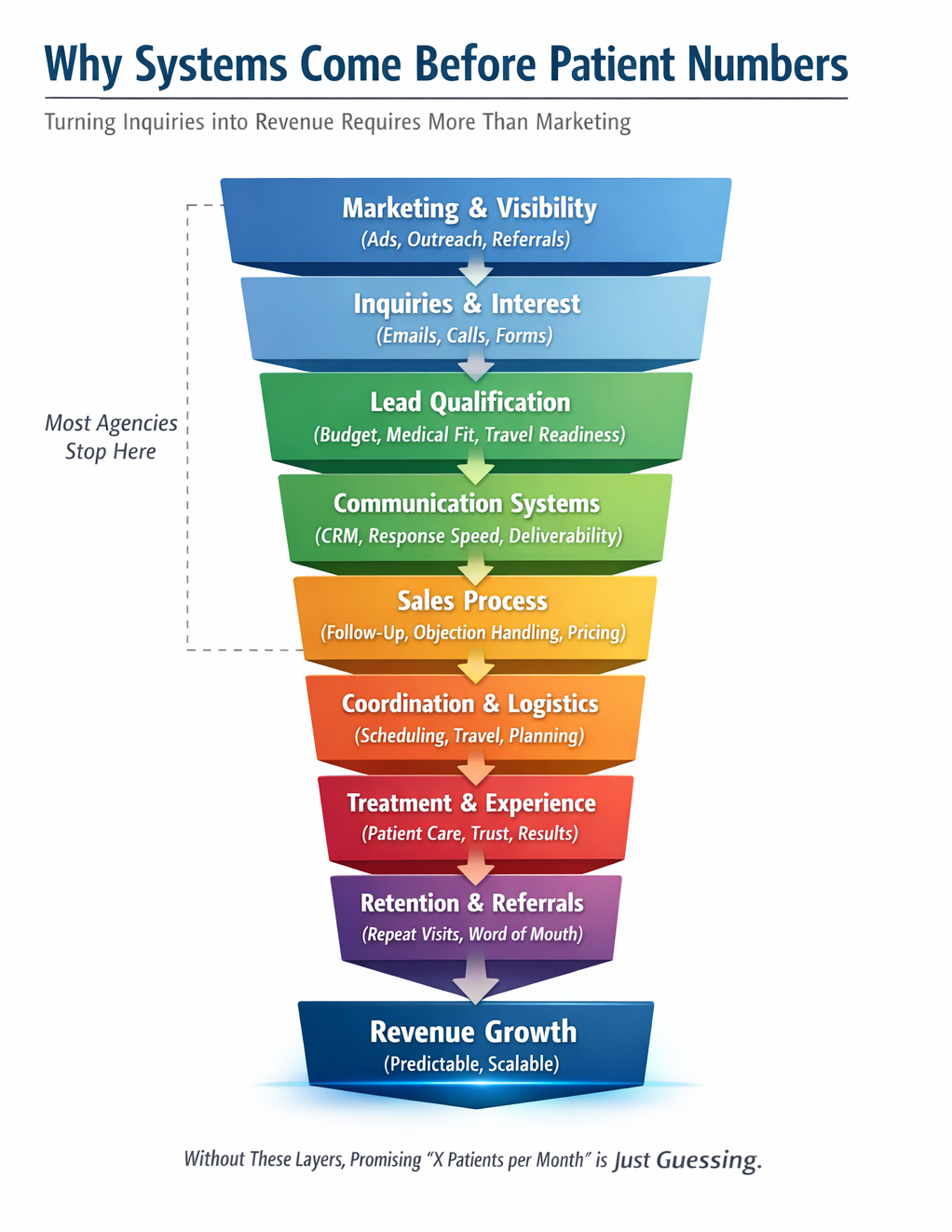
What Can Be Forecasted Responsibly?
Responsible partners do not promise fixed patient numbers. They commit to building the conditions that make predictable revenue possible.
This includes:
Improving conversion rates across inquiries
Reducing cost per acquisition over time
Increasing patient lifetime value
Shortening sales cycles
Increasing predictability and visibility
Once data exists, ranges can be modeled. Trends can be measured. Revenue trajectories can be projected.
But guarantees without systems are fiction.
Why Some Companies Still Promise Numbers
The reason is simple: it sells faster.
Promising “20 patients per month” feels easier than explaining systems, processes, and execution discipline. It also shifts responsibility away from the clinic’s internal operations and onto a single external metric.
Unfortunately, those promises usually collapse once reality intervenes.
The Strategic Difference Clinics Should Understand
There are two types of providers in this space:
One sells traffic and promises numbers.
The other builds businesses and avoids false precision.
The first is transactional.
The second is structural.
Clinics seeking short-term activity may prefer the first.
Clinics seeking enterprise-level revenue and long-term value need the second.
The Right Question to Ask Instead
Rather than asking, “How many patients per month will we get?” clinics should ask:
What systems will be built in the first 90 days?
How will conversion be improved and measured?
How will response times and follow-ups be enforced?
How will sales be trained, monitored, and optimized?
When do early signals typically appear?
When does revenue become consistent?
These questions lead to outcomes that can actually be delivered.
Precision Comes After Structure
Exact numbers feel comforting, but comfort is not the same as accuracy.
In medical tourism, precision comes after structure, not before it. Clinics that invest in systems, processes, and disciplined execution gain something far more valuable than promised patient counts: predictable, scalable revenue.
Any partner unwilling to explain this distinction is not protecting your growth.
They are selling certainty where none yet exists.
Clinics that understand this early are the ones that ultimately win.